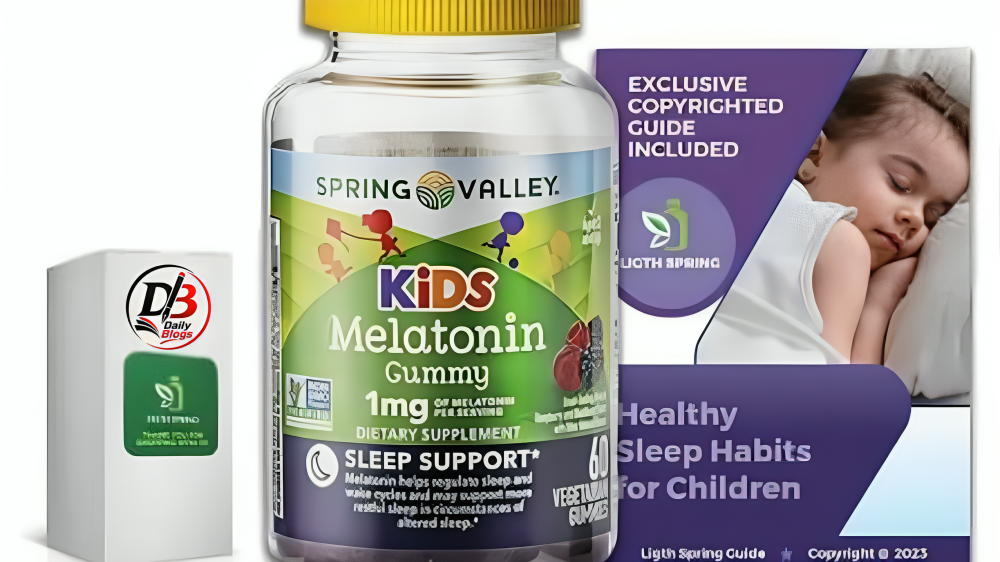
For parents wrestling with a child who simply won’t settle at bedtime, melatonin gummies for kids have become one of the most talked-about solutions on supermarket shelves and pharmacy aisles alike. Marketed as a “natural” sleep aid and dressed up in fruity, chewable form, these gummies promise an easy fix to a problem that has kept generations of parents awake at night.
But easy fixes are rarely as simple as they appear. In recent years, paediatric sleep specialists, poison control centres and public health bodies have all raised questions about how these products are used, how safe they really are, and why so many children are ending up in emergency departments after getting hold of a bottle meant to help them sleep, not harm them.
This guide takes a balanced look at melatonin gummies for kids — how they work, what the evidence says, the risks parents should be aware of, and the questions worth raising with a GP or paediatrician before reaching for the bottle.
What Are Melatonin Gummies and Why Have They Become So Popular?
Melatonin is a hormone the body produces naturally, largely in response to darkness, as part of the internal process that regulates the sleep-wake cycle. Melatonin gummies are a synthetic, chewable version of that hormone, flavoured and shaped to resemble sweets, which is precisely why they’ve become such an easy sell to time-poor, sleep-deprived parents.
Their rise in popularity tracks a broader trend. Melatonin use among adults in the United States roughly quintupled between the late 1990s and late 2010s, and children’s use has climbed alongside it. Social media has played a role too, with parenting content often presenting melatonin gummies as a harmless, natural nightly ritual rather than a supplement that warrants the same caution as any other medicine.
The appeal is understandable. Bedtime battles are exhausting, gummies are far easier to administer than a tablet or liquid, and the “natural hormone” framing makes the product feel gentler than it might otherwise seem. Yet that framing can be misleading, and it’s worth unpacking why.
How Melatonin Works in a Child’s Body
Melatonin doesn’t sedate in the way a sleeping pill does. Instead, it signals to the body that it’s time to wind down, nudging the internal body clock rather than forcing unconsciousness. In children, this makes it a fundamentally different product to over-the-counter sleep medications, and generally a milder one.
That said, “natural” doesn’t automatically mean risk-free, particularly in a growing body. Children’s endocrine systems are still developing, and researchers have noted there simply isn’t enough long-term data on how nightly melatonin supplementation might affect that development over months or years. The American Academy of Pediatrics has said as much directly: short-term use in children appears relatively safe, but there is not yet sufficient research on what happens with sustained, long-term use.
Are Melatonin Gummies Safe for Children?
This is the question most parents actually want answered, and the honest response is: it depends, and it should never be a decision made without medical input.
Paediatricians generally agree that melatonin is well tolerated in the short term and, for some children, can genuinely help with settling into sleep. Dr Cade Caraballo, a paediatrician quoted by Children’s Health, notes that melatonin is well tolerated for most children when used under a physician’s guidance, though he also points out that gummies may absorb less reliably than dissolvable tablets or liquid formulations, meaning a chewable sweet isn’t necessarily the most effective delivery method even when it’s the most popular one.
The bigger safety concern isn’t really about melatonin as a hormone, it’s about the product itself. A 2023 analysis published in JAMA examined 25 melatonin gummy products and found that 22 of them, or 88 per cent, were inaccurately labelled. Some contained as little as 74 per cent of the melatonin stated on the packaging, while others contained more than three times the labelled amount. Because dietary supplements aren’t subject to the same pre-market approval as medicines, manufacturers aren’t required to prove the accuracy of their labelling before a product reaches shop shelves.
Layer on top of that the fact that gummies look and taste like sweets, and you have a product that’s genuinely appealing to small children who don’t understand the difference between a treat and a supplement.
The Risks Parents Often Underestimate
The most pressing safety issue with melatonin gummies for kids isn’t intentional overuse by parents; it’s accidental ingestion by children who find the bottle themselves. In the United States, calls to poison control centres about paediatric melatonin exposure rose by more than 500 per cent between 2012 and 2021, and emergency department visits for unsupervised melatonin ingestion by infants and young children rose sharply over a similar period. Roughly half of these cases involved gummy formulations specifically, largely because they’re stored within easy reach and mistaken for sweets.
The good news is that most of these incidents don’t result in hospitalisation. Signs of a melatonin overdose can include nausea, vomiting, an unusually fast heartbeat, or low blood pressure, and while serious complications are uncommon, any suspected overdose warrants prompt medical attention.
There’s a second, quieter risk worth flagging too: relying on melatonin as a nightly crutch can sometimes mask an underlying issue, such as anxiety, a poor sleep environment, or an undiagnosed condition like restless legs syndrome, that would benefit from proper assessment rather than a nightly supplement.
Dosage: Why “Ask Your Doctor” Isn’t Just a Disclaimer
Because melatonin products aren’t tightly regulated, there is no single, universally agreed dose for children, and this is precisely why paediatricians are so consistent in urging parents not to self-dose. Reported doses used in research and clinical practice for children vary considerably depending on age, weight and the underlying reason for sleep difficulty, and what works for one child may be entirely inappropriate for another.
The American Academy of Sleep Medicine issued formal guidance advising parents not to give melatonin to children without first speaking to a paediatrician. This isn’t overcautious box-ticking: it reflects genuine uncertainty in the research community about optimal dosing, long-term safety, and how melatonin interacts with other conditions or medications a child might have.
For children with certain neurodevelopmental conditions, such as autism spectrum disorder or ADHD, melatonin is sometimes used under close medical supervision as part of a broader sleep management plan, with routine follow-up. This is a very different scenario to a parent picking up a bottle of gummies at the supermarket and administering it without any professional guidance, and it underlines why a conversation with a healthcare provider should always come first.
Safer, Non-Supplement Alternatives Worth Trying First
Sleep specialists consistently point out that many childhood sleep problems can be improved without any supplement at all. A consistent bedtime routine, a dark and cool bedroom, limiting screen time in the hour before bed, and keeping wake-up times steady even at weekends can make a meaningful difference over a few weeks.
Where these measures alone aren’t enough, and a doctor does recommend melatonin, choosing a reputable brand matters. Products that carry third-party testing certification offer more assurance that the labelled dose matches what’s actually inside, given how inconsistent labelling has been shown to be across the wider market.
Storage: The Most Overlooked Safety Step
Given how many accidental ingestions involve gummies specifically, storage deserves its own mention. Melatonin gummies should be kept exactly as any other medicine would be: in their original container, out of a child’s sight and reach, ideally in a locked cabinet, and never left on a bedside table or kitchen counter where they might be mistaken for sweets by a curious toddler or older sibling.
Quick Facts: Melatonin Gummies for Kids
| Detail | Information |
| What it is | A synthetic, chewable form of the naturally occurring sleep hormone melatonin |
| Regulatory status | Sold as a dietary supplement; not pre-approved by regulators for safety or label accuracy |
| Typical use | Short-term aid for sleep onset difficulties, generally under medical guidance |
| Common concern | Inconsistent labelling; actual melatonin content can differ significantly from what’s stated |
| Main safety risk | Accidental ingestion by young children due to sweet-like appearance |
| Medical guidance | Paediatricians and sleep specialists advise consulting a doctor before use |
| Longer-term data | Limited research on effects of sustained, long-term use in children |
Why This Conversation Matters Beyond Bedtime
The debate around melatonin gummies for kids reflects a wider pattern in how supplements are marketed to time-strapped parents: as gentle, natural, low-risk solutions to problems that are often more complex than a single product can solve. That framing isn’t necessarily dishonest, but it can obscure genuinely important nuances, such as inconsistent dosing between brands, the risks of accidental ingestion, and the gaps that still exist in long-term safety research.
None of this means melatonin has no place in helping a child sleep. Used thoughtfully, under medical guidance, for the right reasons and for a limited period, it can be genuinely helpful for some families. The concern voiced by paediatric sleep experts isn’t about melatonin itself so much as it is about casual, unsupervised use of a product that looks and tastes like a sweet but behaves like a hormone with real physiological effects.
Conclusion
Melatonin gummies for kids sit in an unusual grey area: widely available, heavily marketed, genuinely useful for some children, and yet still surrounded by real uncertainty around dosing, labelling accuracy and long-term safety. The most sensible approach for any parent considering them is the one paediatricians keep repeating: start with sleep habits and environment, talk to a doctor before introducing a supplement, choose a product with verified third-party testing if one is recommended, and store it well away from small hands.
Sleep struggles are exhausting for the whole family, and it’s entirely understandable that a fruity, easy-to-give gummy feels like a welcome relief. But a little caution and a conversation with a healthcare professional can make the difference between a helpful short-term aid and an avoidable trip to the emergency department.